Friday, August 06, 2010
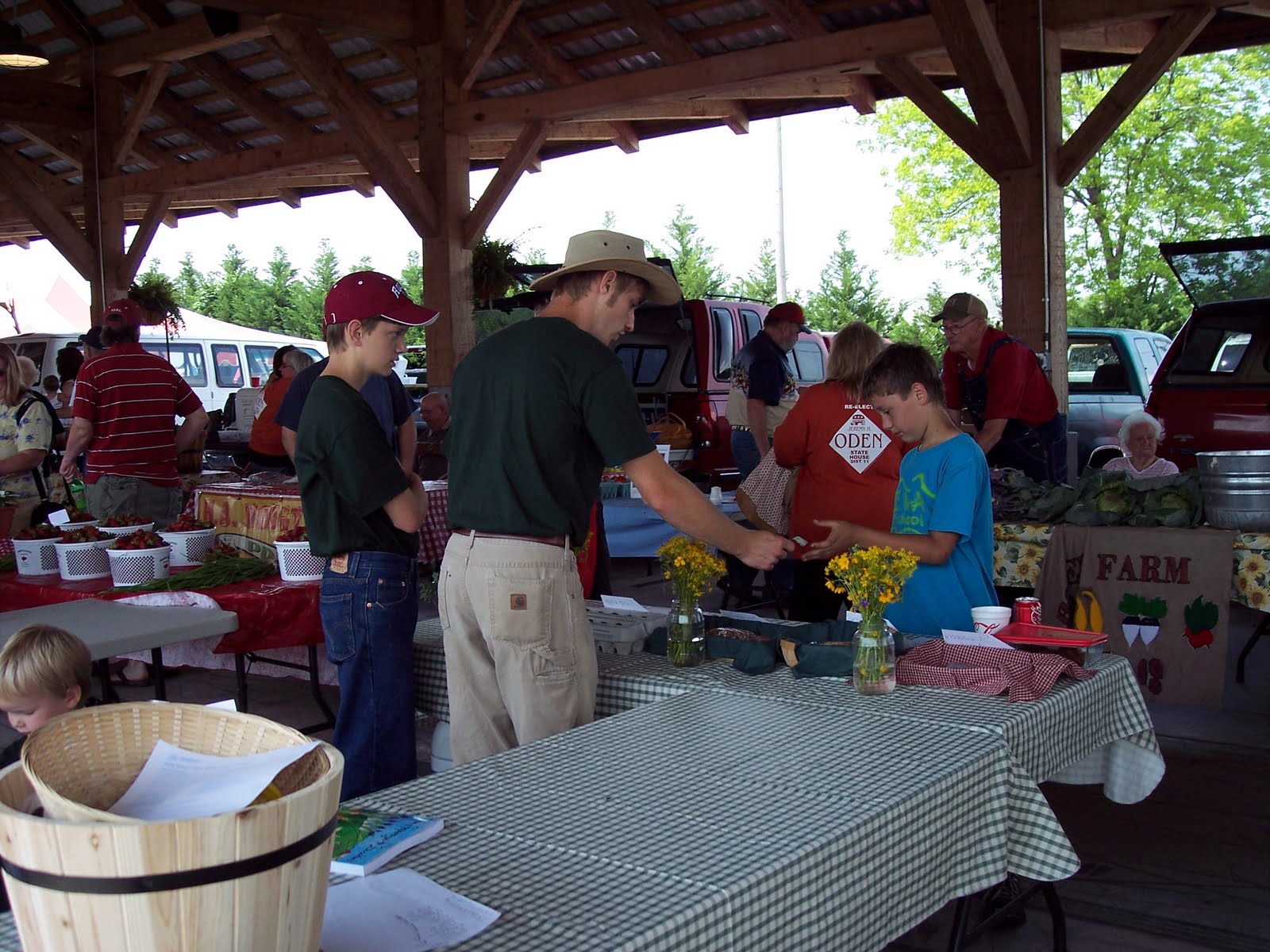
The Market
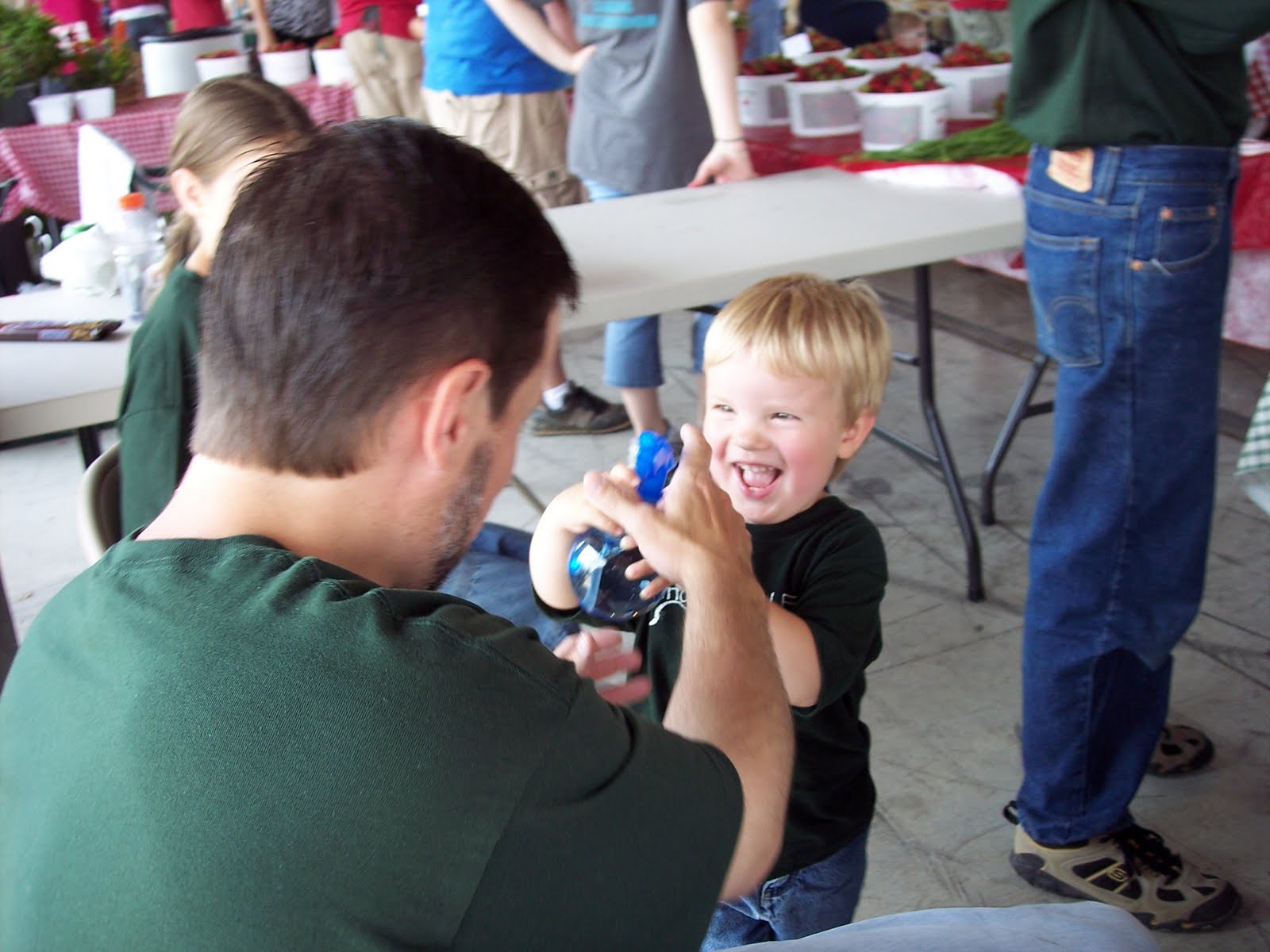
This was the big event of the year- Strawberry Festival and our first day to sell at the market. It was a fun family experience!!
John Deere Ice Cream!
What Flavor?
Sheep Shearing
Springtime on the Farm.....and off
Monday, April 12, 2010
A Stonewall Minute
by Edgar A. Guest
There is no music quite so sweet
As patter of a baby’s feet.
Who never hears along the hall
The sound of tiny feet that fall
Upon the floor so soft and low
As eagerly they come or go,
Has missed, no matter who he be,
Life’s most inspiring symphony.
There is a music of the spheres
Too fine to ring in mortal ears,
Yet not more delicate and sweet
Than pattering of baby feet;
Where’er I hear that pit-a-pat
Which falls upon the velvet mat,
Out of my dreamy nap I start
And hear the echo in my heart.
‘Tis difficult to put in words
The music of the summer birds,
Yet far more difficult a thing—
A lyric for that pattering;
Here is a music telling me
Of golden joys that are to be;
Unheralded by horns and drums,
To me a regal caller comes.
Now on my couch I lie and hear
A little toddler coming near,
Coming right boldly to my place
To pull my hair and pat my face,
Undaunted by my age or size,
Nor caring that I am not wise—
A visitor devoid of sham
Who loves me just for what I am.
This soft low music tells to me
In just a minute I shall be
Made captive by a thousand charms,
Held fast by chubby little arms,
For there is one upon the way
Who thinks the world was made for play.
Oh, where’s the sound that’s half so sweet
As pattering of baby feet?
As patter of a baby’s feet.
Who never hears along the hall
The sound of tiny feet that fall
Upon the floor so soft and low
As eagerly they come or go,
Has missed, no matter who he be,
Life’s most inspiring symphony.
There is a music of the spheres
Too fine to ring in mortal ears,
Yet not more delicate and sweet
Than pattering of baby feet;
Where’er I hear that pit-a-pat
Which falls upon the velvet mat,
Out of my dreamy nap I start
And hear the echo in my heart.
‘Tis difficult to put in words
The music of the summer birds,
Yet far more difficult a thing—
A lyric for that pattering;
Here is a music telling me
Of golden joys that are to be;
Unheralded by horns and drums,
To me a regal caller comes.
Now on my couch I lie and hear
A little toddler coming near,
Coming right boldly to my place
To pull my hair and pat my face,
Undaunted by my age or size,
Nor caring that I am not wise—
A visitor devoid of sham
Who loves me just for what I am.
This soft low music tells to me
In just a minute I shall be
Made captive by a thousand charms,
Held fast by chubby little arms,
For there is one upon the way
Who thinks the world was made for play.
Oh, where’s the sound that’s half so sweet
As pattering of baby feet?
Thursday, April 01, 2010
A Stonewall Minute
Thought I'd sneak a minute in (since the blog has been dead so long). This is a poem we particularly like:
It Couldn't Be Done
by Edgar A. Guest
by Edgar A. Guest
Somebody said it couldn't be done.
But he with a chuckle replied,
That maybe it couldn't, but he would be one
Who wouldn't say so 'till he'd tried.
So he buckled right in with a trace of a grin
On his face. If he worried, he hid it.
He started to sing as he tackled the thing
That couldn't be done. And he did.
Somebody scoffed, "Oh, you'll never do that
At least no one ever has done it."
But he took off his coat, and he took off his hat,
And the first thing we know, he'd begun it.
With a lift of his chin and a bit of a grin,
Without any doubting or "quit-it".
He started to sing as he tackled the thing
That couldn't done. And he did it.
There are thousands to tell you it cannot be done.
There are thousands to prophesy failure.
There are thousands to point out to you, one by one,
The dangers that wait to assail you.
But just buckle in, with a bit of a grin;
Just take off your coat and go to it.
Just start in to sing as you tackle the thing
That cannot be done--and you'll do it!
Saturday, February 20, 2010
Tuesday, December 15, 2009
Happenings on the Farm
An update on the farm, complete with pictures, is long overdue. I have been kept fairly busy with college courses, but we have made some progress over the past few months. I processed all of my chickens and turkeys before Thanksgiving, and we have begun preparations for next year's season. Now that I have completed my first college semester, I'm free to devote all of my attention to the farm. We have many plans that we are going to be working through this winter, and with God's blessing, we hope to make an appearance at our farmers' market next spring in order to begin serving the large customer base in our county.

I processed my first flock of turkeys a few days before Thanksgiving. Despite a few technical impediments, all of the turkeys were delivered on time. We learned that turkeys are quite different than chickens, particularly in size and strength, but we still look forward to growing more next year. ;)
On my birthday, we hired a trackhoe (and owner) to do some work in our fields. The machine weighs 30,000 pounds, which was quite enough heavy metal to dig out all of our stumps, as well as putting in a drainage trench along our very wet garden plot. Everything looks like a mess, at the moment... but progress can look messy at times.
Saturday, December 05, 2009
Wednesday, December 02, 2009
This Is Why Teddy Is My Hero
Theodore Roosevelt, Speech Before the Hamilton Club
Chicago, April 10, 1899
Monday, November 16, 2009
Of Food, Inc.
I knew that Food, Inc. would thoroughly expose the industrial system, simply by the fact that Eric Schlosser, Joel Salatin, and Michael Pollan all contributed to the film. I prefer a slightly more rational, and less emotional, presentation of even scary facts, so the horror music and emotional appeal weren't my favorite parts. On the other hand, it is important to take food safety to a personal level, and I believe that the story of the death of Kevin Kowalcyk (caused by E. Coli-contaminated hamburger) made the situation seem much more real and personal. The images of conventional poultry, pork, and cattle production were well contrasted by the Edenic appearance of Joel Salatin's Polyface Farm.
The scenes of poultry, pork, and beef processing were an honest representation and quite appalling. I was glad to see how broad a range of issues the film covered, from contamination of the meat to worker safety. I imagine that the average American consumer seeing this film would be very surprised to see how their meat is processed. The film also reveals just how secretive the food industry is. As Joel Salatin said in the film, (I paraphrase) "If all of the slaughterhouses in the United States were built with glass walls, people would change the way they eat in a heartbeat."
Food, Inc. does not stop by exposing the meat industry; no, that is mere child's play compared to the control of farmers by seed companies the seed company, Monsanto. This "axis of evil" in the agricultural world has not only cornered the seed market, but claims complete ownership of seeds which have been genetically modified to resist Monsanto herbicides and pesticides. The farmers interviewed in the film reveal the legal tactics that Monsanto uses to control their customers, such as filing lawsuits (on grounds of the slightest evidence) against farmers suspected of saving Monsanto seed, even in circumstances when Monsanto knows that they can't win. In one case, Monsanto filed suit against the owner of a seed cleaning business, claiming that he was encouraging farmers to violate patent laws.
The revelation that most of our food comes from corn is surprising for the average eater, I'm sure. The nutritional impact of such a monoculture in food is not discussed in detail in the film, but Michael Pollan goes into greater detail in Omnivore's Dilemma, for those who wish to learn more. In Defense of Food, another of Pollan's books, is also well worth reading; it presents a view of eating that is profound in its simplicity.
This negative information about our food was a very thorough exposé of industrial food processing and factory farms. The other half of the movie presents the positive side of food, the alternative. This is where I was disappointed in the film, as this message of hope is delivered in two very different ways, without ever reconciling them. The first alternative system is espoused and explained by Joel Salatin, who advocates the idea of a food system that is decentralized and comprised of thousands of small farms across the nation. These small farms serve their community with food grown in a sustainable fashion that is humane to both the animals and the farmer, beneficial for the soil, and much more transparent for the sake of the consumer.
The second alternative presented is actually quite different, though someone new to the world of organic food may not have noticed, and the film seemed to blend the two as if they are harmonious. This alternative is what Michael Pollan refers to as "Big Organic", or simply an indutrial system producing food organically. This is certainly superior to conventional industrial food, but if you have a disease, is it better to control the symptoms or remove the problem? The Big Organic side is presented by Gary Hirshbeg, CEO of Stonyfield Farm, who has a passion for organics, but believes that the food solution lies in business. His factories are run in the most environmentally conscious way possible, and his viewpoint is that every dollar in organic yogurt that Stonyfield sells is benefiting the earth. Stonyfield Farm yogurt is marketed to Wal-Mart, which Hirshberg sees as a breakthrough for organic food.
Thus, two views are presented: one advocates buying from local farmers and farmers' markets, while the other supports an organic reform of the industrial system. I had hoped that Joel Salatin's vision of a country filled with small farmers who could feed their communities- which, by the way, is also far more economically stable- would dominate the positive message of the film. "Industrial organic" is a compromise that will inevitably reduce quality and transparency, the two great goals of farmers such as Joel Salatin. The Big Organic industry may offer a solution which seems more probable, but it still sacrifices the food independence which farmers and activists are fighting for, it maintains the possibility of mass contamination, it is still highly centralized, and requires a great deal of energy (in the form of petroleum) for the processing and shipping of food.
Despite my disappointment with parts of the presentation, I think this film is a breakthrough in many ways. I highly recommend it to the consideration of a candid world.
~Sherlock
Saturday, November 07, 2009
"Happy Birthday!"

Neglected blogs populate the digital graveyards of the internet. Perhaps this is a beneficial problem; there are more than enough well written and edifying blogs to compensate for the failed experiments cluttering the world wide web, now orphaned and dusty. I can understand the reasons that the owners of these blogs might have used to convince themselves that quietly abandoning their sites was the most humane option; there is a certain point at which the embarrassment of reviving the blog outweighs any disappointment that the death of said blog may bring.
Not being easily embarrassed, however, I'm going to bring this blog back to life. I apologize for the long silence, and I hope to have some interesting posts rolling soon. If you are reading this, give yourself a pat on the back for being such a faithful reader. However, you must have been waiting for an update, and you probably need to find a hobby. ;)
~Sherlock
Monday, August 24, 2009
Elianna Grace
Tuesday, August 18, 2009
A Stonewall Minute
Well, the public school systems are underway and all of those children are learning the great Marxist and Socialist ideals that our country was founded upon. They'll be either explicitly or implicitly learning about man's creation in order to take God out of the equation: with science, it will be evolution instead of creation; with morality, it will be Fascism instead of Christianity. They'll be having a moment of silence every morning to meditate, recite the Koran, the pledge of allegiance to Obama, etc, etc.
Okay, maybe it's not all that bad, but if the current course continues we're well on the way. I'm reading a book by Jonah Goldberg called Liberal Fascism. One particular point jumped out at me in this book. Goldberg writes: "Crisis is routinely identified as a core mechanism of fascism because it short-circuits debate and democratic deliberation. Hence all fascistic movements commit considerable energy to prolonging a heightened state of emergency." The book points to World War I as giving birth to Fascism, and the American "progressives" as being descendants of the fascist way.
Now, here we are and all I hear from the media is that health care is broken and the swine flu is going to kill us all! This may not be the height of emergency that World Wars afforded others, but it's all the "Administration" has got to grasp for right now. There's no doubt that the swine flu will be an avenue for the "Administration" to attempt to force legislation, or at least coerce the people, all justified by "achieving the common good" (i.e., denying the people their individual rights to choose). It jumped out at me how both the past and current "Administrations" have taken advantage of states of emergency in order to circumvent democratic deliberation.
I just thought you'd like to know that your government is using these same fascist tactics on WE THE PEOPLE. Now with the kids congregating in all the public flu pool schools, keep an eye on how the government plays its "emergency" card. I think it will be very telling of how far we've gotten away from being a free republic, and how close we're leaning towards becoming a socialist state. Think about this the next time the "Administration" mentions the "common good".
Stonewall out
Friday, August 14, 2009
Farm Friday
This week we have continued preparing the fields which we will plant in next year. We have almost finished building a fence to divide our fields from the rest of the pasture. The next step will be to grind all of the stumps and plant a cover crop.
I also planted some late tomatoes in our hoophouse this week. We hope that they will produce late into the fall, and I'm interested to see how long they will last. Some farmers I've talked to have used hoophouses to grow tomatoes right into January.
Subscribe to:
Posts (Atom)